

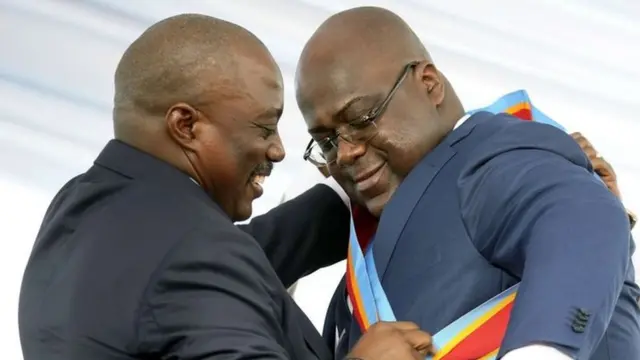
Fresh remarks by former United States Assistant Secretary of State for African Affairs Tibor Nagy have reopened deep political wounds in the Democratic Republic of Congo, reviving long-standing claims that President Félix Tshisekedi did not genuinely win the country’s disputed 2018 presidential election but was instead elevated to power through a deal backed by both Washington and former president Joseph Kabila.
Nagy, who served as Washington’s top diplomat for Africa during the Trump administration, wrote this week that supporting Tshisekedi after the controversial poll remains one of the biggest regrets of his diplomatic career.
“One of my greatest regrets from my time as US AsstSecState for Africa was advocating for US to support Tshisekedi as winner of Congo’s 2018 election,” Nagy said.
“I thought he would really be different and advance the Congolese people’s interests. How wrong I was!”
The statement has intensified debate around the legitimacy of Tshisekedi’s presidency at a time when fears are growing that he could seek to extend his stay in office beyond constitutional limits.
Speaking at a press conference in Kinshasa this week, Tshisekedi hinted that he may consider remaining in power after his current mandate expires in 2028.
“I have not asked for a third term, but I’m telling you — if the people want me to have a third term, I will accept,” he said.
He also warned that elections may not be held on schedule if insecurity persists in eastern Congo, where the M23 rebellion has captured large areas of North Kivu and South Kivu, including the strategic cities of Goma and Bukavu.
“If we cannot end this war, unfortunately, we will not be able to hold the elections in 2028,” Tshisekedi said.
The comments immediately triggered criticism from opposition figures and civil society actors who accuse the Congolese leader of laying the groundwork for an unconstitutional extension of his rule.
For many critics, however, the controversy surrounding Tshisekedi did not begin with the question of a third term. It began with the 2018 election itself.
The December 30, 2018 general election was officially presented as a historic democratic breakthrough because it produced Congo’s first formal transfer of presidential power since independence in 1960.
Kabila, who had ruled since 2001 following the assassination of his father Laurent-Désiré Kabila, was constitutionally required to leave office in 2016 but repeatedly delayed elections amid mounting protests and international pressure.
When elections were finally held, the main contenders were Tshisekedi, opposition heavyweight Martin Fayulu, and Kabila-backed ruling party candidate Emmanuel Ramazani Shadary.
Official results announced by the electoral commission awarded Tshisekedi victory with slightly below 38 percent of the vote.
Yet from the very beginning, the result was fiercely contested.
Fayulu rejected the outcome outright, insisting he had overwhelmingly won the election. The influential Catholic Church in the Democratic Republic of the Congo, which deployed tens of thousands of observers nationwide, also stated that its independently collected data did not match the official results announced by electoral authorities.
Several international media investigations and diplomatic leaks later suggested that Tshisekedi may have reached a political arrangement with Kabila to facilitate a controlled transfer of power that would preserve the former president’s influence while blocking Fayulu from taking office.
Within Congo and across parts of Africa, a widely held belief emerged that Tshisekedi’s official 38 percent tally itself may have overstated his real electoral support.
Critics argued that Fayulu had generated far greater momentum nationally and that Tshisekedi’s comparatively modest official score reflected how weak his actual standing may have been before what many perceived as a negotiated political settlement.
Although Western governments eventually endorsed the transition in the name of stability and the avoidance of violence, Nagy’s latest comments are now being interpreted by critics as indirect confirmation that Washington knowingly backed Tshisekedi despite serious doubts about the credibility of the result.
The United States at the time was heavily invested in ensuring Congo avoided a violent post-election crisis after years of instability under Kabila.
For Kabila, analysts argued, Tshisekedi represented a less threatening option than Fayulu because he was seen as more willing to coexist with the entrenched political and security networks built during Kabila’s nearly two decades in power.
That uneasy arrangement initially defined Tshisekedi’s presidency.
After taking office in January 2019, Tshisekedi governed in coalition with Kabila’s political bloc, which retained control of parliament, provincial structures and significant elements of the security establishment.
But relations between the two men later collapsed.
By 2020 and 2021, Tshisekedi had broken away from Kabila’s coalition and formed a new parliamentary alliance known as the Sacred Union, effectively dismantling Kabila’s influence within the central government.
Since then, political hostility between the former allies has intensified sharply.
Tshisekedi’s camp has accused Kabila-linked networks of undermining state authority and maintaining influence in eastern Congo’s armed conflicts, while Kabila’s allies accuse Tshisekedi of authoritarianism and political persecution.
Tensions escalated further in March this year when drone explosions struck parts of Goma amid fighting linked to the M23 rebellion.
International reports indicated that one of the explosions occurred approximately 50 metres from a residence associated with Kabila.
The attack reportedly killed at least one person, including French UNICEF worker Karine Buisset, although some reports cited multiple fatalities.
The M23 rebel movement accused the Congolese army of carrying out the strikes and alleged that locations linked to both rebel authorities and Kabila were targeted.
While Kinshasa denied deliberately targeting the former president, the incident deepened suspicions among Kabila’s supporters, some of whom viewed it as a warning or attempted intimidation.
Now, with eastern Congo still engulfed in insecurity and Tshisekedi openly suggesting elections could be delayed, Nagy’s remarks have revived uncomfortable questions about whether Congo’s current political crisis is rooted in the unresolved legitimacy disputes of 2018.
For Tshisekedi’s critics, the fear is no longer only about whether he fairly won his first election, but whether a presidency many believe was externally legitimised could ultimately evolve into a prolonged hold on power.
